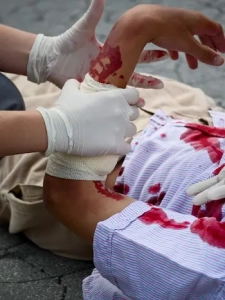
First Aid at Work (Catastrophic Bleeds)

First Aid at Work (Catastrophic Bleeds)

Qualification title: QNUK Level 3 Award in First Aid at Work (Management of Catastrophic Bleeding) (RQF)

Qualification accreditation number: 603/2561/6

Description: This qualification assists employers to meet the first aid requirements under the Health and Safety (First Aid) Regulations 1981, particularly in higher risk workplaces.

The qualification includes the management of catastrophic bleeding.

Pricing

  • People
  • 4
  • 6
  • 8
  • 10
  • 12
  • Pricing
  • £820 + VAT
  • £940 + VAT
  • £1060 + VAT
  • £1180 + VAT
  • £1300 + VAT

First Aid at Work (Catastrophic Bleeds)

First aid at work (catastrophic bleeds) will provide learners with the skills, knowledge, and understanding to support individuals in a first aid role and manage catastrophic bleeding injuries in the workplace.

This qualification is ideally suited to high-risk working environments such as construction, engineering, or plant machinery operations.

The First Aid at Work (Catastrophic Bleeds) qualification is widely recognised and accepted throughout the United Kingdom.

Accredited by Qualifications Network UK, regulated by Ofqual, and complies with current guidelines set forth by the Health and Safety Executive (HSE) and the Resuscitation Council UK.

First Aid at Work (Catastrophic Bleeds)

first aid at work (catastrophic bleeds)

First Aid at Work (Catastrophic Bleeds)

This 3-day, 19-hour First Aid at Work (catastrophic bleeds) course teaches learners to identify and respond to common workplace injuries and conditions.

First aid at work (catastrophic bleeds) teaches you to perform CPR on an unconscious, non-breathing person, use an AED safely, manage an unconscious but breathing person, and monitor them until ambulance crews arrive.

You will gain the skills, knowledge, and confidence to effectively treat a wide range of ailments and conditions in your workplace.

Includes treating a casualty who is choking, having a seizure, being poisoned, or experiencing medical shock, as well as those suffering from sudden cardiac arrest (SCA), asthma attacks, drowning, crushing injuries, life-threatening bleeds, minor burns, scalds, and other wounds.

Also learning how to use tourniquets safely, trauma dressings, and haemostatic agents.

Companies and awarding organisations have collaborated to create first aid courses for high-risk industries.

Course Learning Outcomes

Understand the role and responsibilities of a first aider in reference to:

  • Preventing cross-infection
  • Importance of recording incidents and actions
  • Using available equipment
  • Assessing the situation and circumstances to act safely, promptly, and effectively in an emergency

Be able to provide first aid to a casualty who:

  • is unresponsive but breathing normally
  • is unresponsive but NOT breathing normally
  • is wounded and bleeding
  • has external bleeding
  • is suffering from medical shock
  • is having a heart attack
  • is having a stroke
  • has bites or stings
  • has had an electric shock
  • has injuries to the eyes, bones, muscles, and joints
  • has a chest injury
  • has splinters, cuts, grazes, or bruising
  • has minor burns or scalds
  • is having a seizure
  • has sudden poisoning
  • is suffering from anaphylactic shock
  • has diabetes
  • has asthma
  • is suffering the effects of extreme heat or cold

Be able to demonstrate control of external bleeding:

  • using a trauma dressing
  • using a haemostatic dressing
  • using a tourniquet

Course Pre-requisites

This qualification equips individuals aged 16 and older to take on the role of a workplace emergency first aider.

Learners aged 14 to 16 can also pursue this qualification, but employers should not rely solely on them to fulfil first aider responsibilities.

Due to the assessment’s nature, students should have a strong command of the English language to understand and apply the necessary assessment methods.

Ideally, learners should possess at least Level 2 literacy and numeracy skills or equivalent qualifications.

They will need to demonstrate first aid procedures in a workplace environment, including performing CPR on a casualty lying on the floor.

Course Duration

19 guided learning hours (3 days)

Course Tests

Multiple-choice question paper.

  • A minimum of 70% required to pass this part of the course (28 out of 40)

Practical Observations.

  • Learners must be able to perform relevant practical tasks on the floor during the summative assessments.
  • 100% pass mark required.

The assessment will take place under examination conditions; i.e., learners will sit at least 1.25 metres apart and will not be allowed to confer during the examination. No books, including dictionaries, will be permitted during the examination.

Course Qualification

Learners will receive an Ofqual-regulated QNUK Level 3 Award in First Aid at Work (Management of Catastrophic Bleeds (RQF) qualification if they complete all the practical course components and the final multiple-choice exam.

The certificate is valid for 3 years after the course’s assessment date.

Each successful learner will receive:

  • QNUK Level 3 Award in First Aid at Work (Management of Catastrophic Bleeds) (RQF)
  • QNUK Level 3 Award in First Aid at Work (Management of Catastrophic Bleeds) (RQF) (PDF certificate)
  • QNUK qualification card for wallet or purse

Geographical Coverage

This qualification is available across the UK and internationally.

Learners are assessed against the UK Resuscitation Council guidelines.

We Can Come to You or You Can Come to Us

Our pricing is straightforward and transparent, as it should be.

For our on-site courses, we require a minimum of 4 learners to visit your site or preferred venue. 

To discover what our pricing includes, please complete our course inquiry form.

We will respond within a couple of hours during business hours on weekdays.

Additionally, we offer first-aid courses at our training centre in Rugby, Warwickshire.