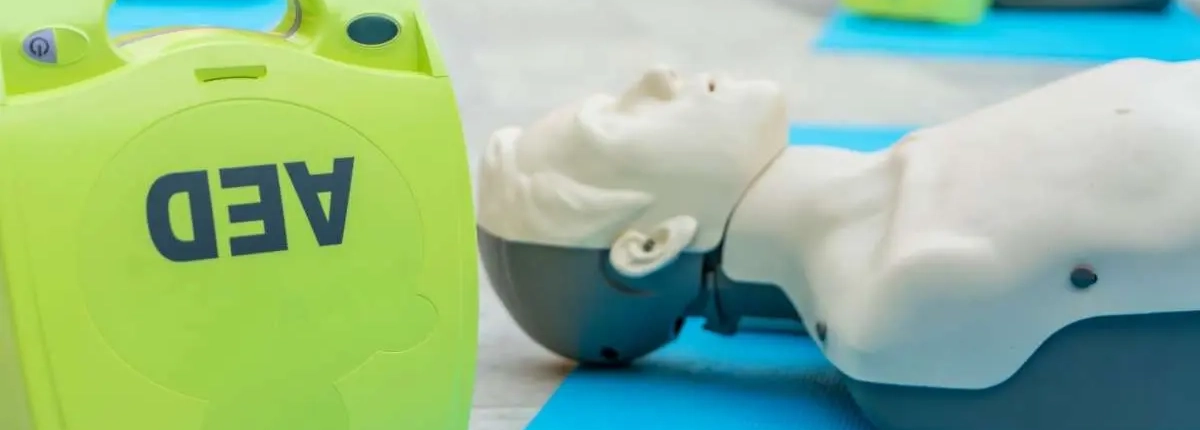
Defibrillators do save lives

Defibrillators do save lives

It is not uncommon for people to express the view that AEDs (also known as defibrillators) are challenging to operate.

Some learners enrolled in our first aid courses share this sentiment.

However, these learners are pleasantly surprised to discover that the training AEDs are surprisingly simple to operate, once they follow the instructions and listen to the machine.

They initially believed that only trained medical professionals could operate them, but soon learned that anyone could do so.

Recently, we demonstrated this point by coaching an 81-year-old man and a 4-year-old boy on how to use a training defibrillator.

And guess what? They both performed CPR while using the training defibrillator on a manikin.
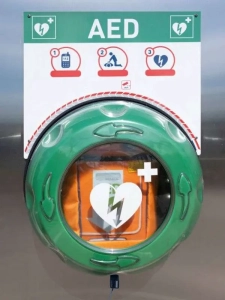
defibrillators do save lives

You have just got to press that GREEN button to fire it up

Press the green button to turn on the AED (defibrillator).

While setting up, the machine will tell you to place the pads on the casualty’s body and not touch them while it analyses their heart.

The AED (defibrillator) will then determine whether or not a shock is required.

That is all there is to it, and there is nothing complicated about using an AED. It is simply a device that provides instructions.

Defibrillators (AEDs) are difficult to use?

If AEDs are so tricky to use, why are they in so many public places these days? I’m sure you’ve seen them while going about your daily business.

Shopping malls store defibrillators in secure cabinets on their walls, which feature keypads for access.

Recently, a quaint village in the Cotswolds installed a defibrillator inside an old red telephone box.

I even found one on the outside wall of a funeral director’s office, which surprised me and made me smile.

How can I find one in an emergency?

If a public AED registers with the national system, the ambulance service will be able to locate the closest one for a casualty in need.

At the nearest one, they will ask for the cabinet number or location and give you the secure box code.

Retrieve the AED and hygiene pack, and return them to the casualty.

Defibrillator (AED) training has been inclusive in first aid training since 2015

We have included defibrillators (AEDs) in all courses since 2015 because they raise awareness that they save lives.

First aid courses for the workplace, such as the QNUK Level 3 Award in Emergency First Aid at Work (RQF) and the QNUK Level 3 Award in First Aid at Work course (RQF), have AED training included as standard, and this meets all HSE and UK Resuscitation Council guidelines.

We even have specialist 1/2-day courses on how to use them, and our QNUK Level 3 Award in Responding to Incidents with an AED (RQF) and our QNUK Level 2 Award in Basic Life Support (Adult and Child) (RQF) have proven popular with members of the public.

While it is true that a first responder would have the knowledge to provide the best possible CPR, and yes, this would make a greater difference, if you do nothing, that person will most likely die or suffer severe disabilities for the rest of their life.

They can restart the heart… (WHAT….)

Another common misconception is that AEDs can restart hearts. In reality, AEDs stop the heart to allow it to restart and regain its natural rhythm, and the AED will monitor the heart and ONLY SHOCK again if necessary.

A person experiencing a serious cardiac arrest (SCA) has a 70% chance of survival if they use an AED (defibrillator) within the first three minutes; every minute that passes reduces that chance by 10%.

So early intervention with an AED is key for that person’s survival.

Can using one make a bad situation worse?…(NO it cannot)

Using an AED won’t exacerbate the situation; it will inform you if a shock is necessary.

The AED will monitor the person’s heart and store data on the machine so the ambulance crew can download and send it to the hospital.

Where can I learn to use an AED?

First aid training providers throughout the country provide AED training as standard on first aid courses in the workplace, and many have standalone courses that last around ½ a day.

Defibrillator training has increased with us over the last 5 years, and many businesses today have defibrillators in their workplaces because they realise the faster they can get a defibrillator to someone who requires it, the bigger the difference in that person’s outcome.